Ontology: The Symbolic Lineage
Origin, the philosophy of being, what exists — and how it came to be categorized.
One question, asked for twenty-four centuries.
What is there? Quine's answer — everything — is famously correct and famously useless. The interesting question was never the answer. It was the machinery you have to build before the answer means anything: what counts as a thing, what counts as a kind, and who decides.
This note traces one thread through that history: the symbolic lineage — the tradition that holds that being can be carved into named categories, arranged in a structure, and written down. It is a straight line from a Greek list of ten to a W3C specification, and the line is not a metaphor. Aristotle's Categories reaches modern software through a chain of translations, each of which is documented and datable.
There is a rival tradition — being as flow, process, becoming, the ineffable — running from Heraclitus through Whitehead to the connectionists. It appears here only where it collides with the symbolic line, and the last section argues that the collision is now the most interesting thing happening in the field.
Aristotle draws the first list. c. 350 BCE · Categories, Metaphysics
Plato had put reality in a realm of Forms, with the visible world as a degraded copy. Aristotle's move — the one everything downstream inherits — was to bring the structure back into the world and then ask what shape it has.
Being is said in many ways.
τὸ ὂν λέγεται πολλαχῶς · Metaphysics Γ.2, 1003a33
That sentence is the origin of the entire discipline. If "is" meant one thing, there would be nothing to categorize. Because it means several, someone has to say which — and the Categories is the first attempt: ten highest kinds, under which everything sayable falls.
| Greek | Category | Answers the question |
|---|---|---|
| οὐσία | Substance | What is it? — the only category that exists independently; the other nine exist in it |
| ποσόν | Quantity | How much? |
| ποιόν | Quality | What sort? |
| πρός τι | Relation | Related how? |
| ποῦ | Place | Where? |
| ποτέ | Time | When? |
| κεῖσθαι | Position | In what posture? |
| ἔχειν | State / having | In what condition? |
| ποιεῖν | Action | Doing what? |
| πάσχειν | Passion | Undergoing what? |
The asymmetry matters more than the list. Substance is primary; everything else is predicated of it. That single decision — that reality has bearers and properties borne, and they are not the same kind of thing — is why every database schema, every class hierarchy, and every RDF triple has a subject slot that behaves differently from the rest.
Porphyry draws the first diagram · c. 270 CE
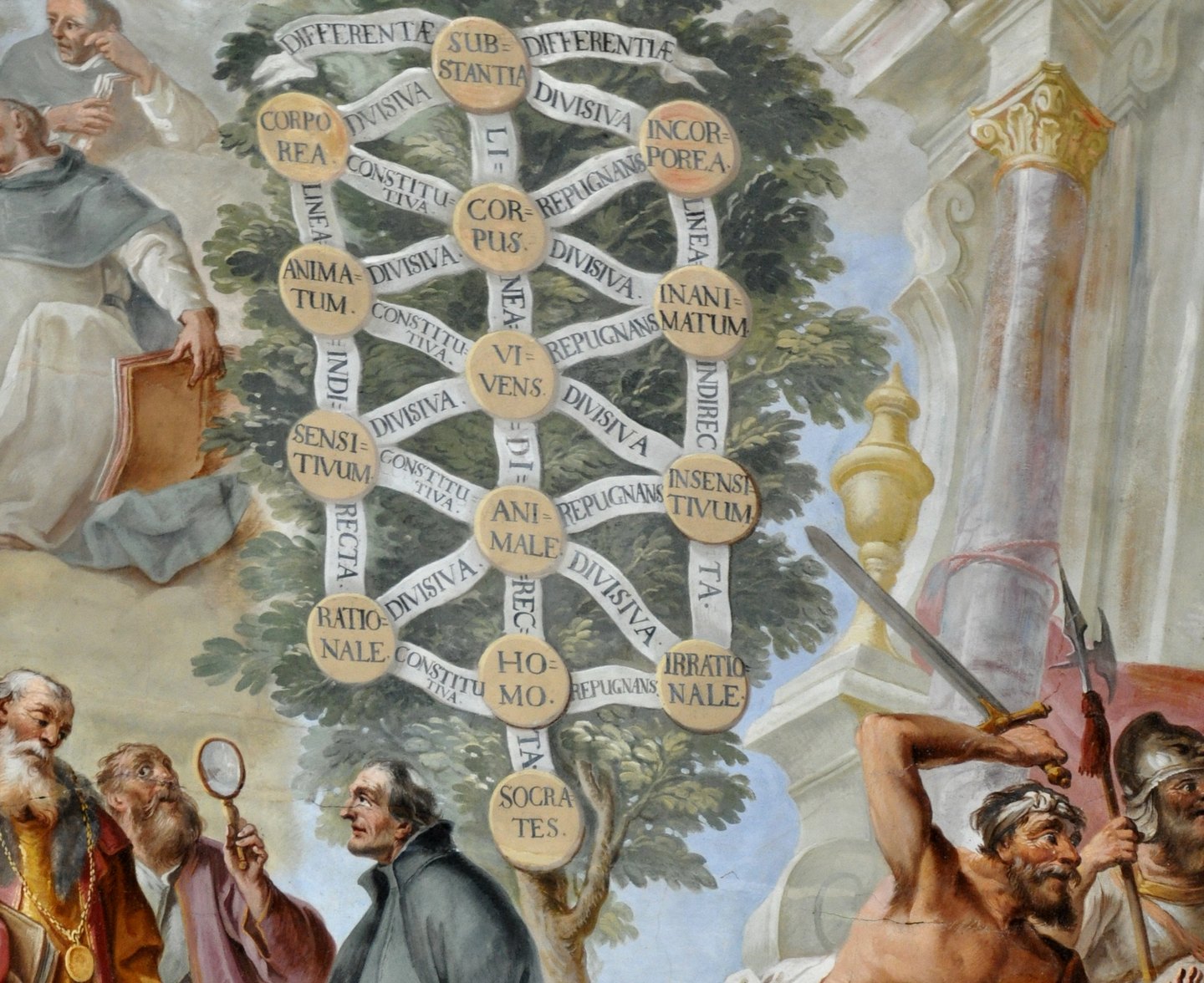
Porphyry's Isagoge was meant as a beginner's introduction to the Categories. It became, for a thousand years, more studied than the thing it introduced — and it contributed the single most consequential picture in the history of knowledge representation.
Substance
 ├── corporeal ─────────── Body
 │                          ├── animate ──── Living thing
 │                          │                 ├── sensitive ── Animal
 │                          │                 │                ├── rational ── Man
 │                          │                 │                │                ├── Socrates
 │                          │                 │                │                └── Plato
 │                          │                 │                └── irrational ─ Beast
 │                          │                 └── insensitive ─ Plant
 │                          └── inanimate ── Mineral
 └── incorporeal ───────── Spirit
Read that shape again. Genus, differentia, species; single inheritance; leaves that are individuals rather than kinds. The single parent is a constraint of the picture, not of the tradition that grew from it — OWL lets a class have many. It is the class hierarchy, drawn seventeen centuries before anyone had a machine to run it on. Porphyry also left three questions deliberately unanswered — do genera and species exist, are they corporeal, are they separate from particulars — and those three deferred questions became the medieval war of §III.
Does "dog" exist, or only dogs? c. 510 – 1350 · Boethius, Abelard, Aquinas, Ockham
Boethius (c. 480–524) translated Porphyry and Aristotle into Latin and wrote the commentaries through which the Latin West would read them for the next seven hundred years. He also took Porphyry's three deferred questions seriously enough to answer them — and thereby started the fight.
The problem of universals is the ontological question in its sharpest form. When we group Rex and Lassie under dog, is dog something real that they share, or a name we find convenient?
| Position | Claim | Chief advocate |
|---|---|---|
| Realism | Universals exist independently of minds and of instances | Plato; extreme scholastic realists |
| Moderate realism | Universals exist, but only in their instances | Aristotle; Aquinas (c. 1265) |
| Conceptualism | Universals exist in the mind as concepts, not in the world | Abelard (c. 1120) |
| Nominalism | Only particulars exist; universals are names | Ockham (c. 1320) |
Entities are not to be multiplied beyond necessity.
Attributed to William of Ockham — the formulation is later, the principle is his
Ockham's razor is usually taught as a rule about explanations. It began as a rule about ontological inventory: do not admit a kind of thing into your account of what exists unless the account fails without it. That is not a stylistic preference. It is a budget — and it is the direct ancestor of Quine's criterion six centuries later.
Customer a real kind with its own identity conditions, or a label over rows that
happen to share a column? Choose realism and you get inheritance, shared semantics, and rigid
migrations. Choose nominalism and you get flexibility, and a system where nobody can say what
anything means. Most production systems are quietly conceptualist and pretend not to be.
Ontology gets a name, and a job. 1606 · 1613 · 1730 — Lorhard, Goclenius, Wolff
The noun ontologia appears in print in Jacob Lorhard's Ogdoas Scholastica (Sankt Gallen, 1606), and shortly after in Rudolf Goclenius' Lexicon philosophicum (1613). It is a Greek compound — ὄντος (of being) + λόγος (account) — built by seventeenth-century Protestant scholastics who wanted a name for the part of metaphysics that deals with being in general rather than with God.
Christian Wolff (Philosophia prima sive Ontologia, 1730) made the division canonical and turned it into curriculum: metaphysica generalis (ontology — being as such) versus metaphysica specialis (God, soul, world). This is the shape Kant inherited, and the shape he demolished.
Kant moves the categories out of the world and into the observer. 1781 · Critique of Pure Reason
Kant accepted that experience is structured by categories and denied that this tells us anything about being. His twelve categories — under quantity, quality, relation, modality — are conditions of possible experience, not divisions of reality. We cannot get behind them to check, because checking would use them.
The proud name of an ontology, which presumes to offer synthetic a priori cognitions of things in general, must give way to the more modest title of a mere analytic of the pure understanding.
Critique of Pure Reason, A247/B303
For a century this reads as ontology's death sentence. In retrospect it is a relocation that the computational tradition would eventually make literal: an ontology is not a map of being, it is the structure a particular knower imposes in order to have experience at all. Swap "knower" for "system" and you have arrived, by a very long road, at Gruber.
Being, recovered — and made unformalizable. 1874 – 1927 · Brentano, Husserl, Heidegger
Franz Brentano's dissertation On the Several Senses of Being in Aristotle (1862) put the ancient question back on the table; his Psychology from an Empirical Standpoint (1874) reintroduced intentionality — that mental states are always about something — which every account of representation since has had to address.
Edmund Husserl split formal ontology (the theory of objects as such — part, whole, dependence, identity) from material or regional ontologies, each governing a domain with its own kinds. That distinction survives directly in modern practice: an upper ontology plus domain ontologies is Husserl's architecture with different funding.
Martin Heidegger (Being and Time, 1927) charged the entire tradition with a foundational error he named the ontological difference: it had spent 2,300 years cataloguing beings (things that are) while forgetting Being (that they are at all). His fundamental ontology proceeds through Dasein — the entity for which its own being is a question.
Quine makes existence a question about theories. 1948 · "On What There Is", Review of Metaphysics 2(5)
Frege and Russell had already done the technical work: existence is not a predicate but a quantifier. "Horses exist" does not attribute a property to horses; it says the class is non-empty. Russell's theory of descriptions (1905) showed how to talk about the present King of France without admitting him to the inventory.
Quine's paper opens with the problem he calls Plato's beard: to deny that something exists, must you not first refer to it? He works through two invented opponents — McX and Wyman — who admit unactualized possibles to make negative existentials work, and dispatches them with the Frege–Russell apparatus. Then comes the line that reorganized the field:
To be is to be the value of a bound variable.
W. V. O. Quine, "On What There Is", 1948
This is the pivot of the whole lineage, and it is worth being exact about what it does. It stops asking what exists and starts asking what a theory is committed to. Regiment your theory into first-order logic; look at what the existential quantifiers range over; that is your ontological commitment. Ontology becomes an audit of a formalism rather than an inquiry into being.
Two consequences follow immediately, and both are load-bearing for everything after. First: ontology becomes relative to a theory — different theories, different commitments, and the question "which is right" becomes a question about which theory to adopt. Second: ontology becomes something you can compute. An inventory extracted mechanically from a formal language is a thing a machine can hold.
Carnap's objection · 1950
Rudolf Carnap ("Empiricism, Semantics, and Ontology") answered that the question splits. Internal questions — do prime numbers exist? — are settled inside a linguistic framework by its own rules, and are trivial. External questions — do numbers really exist, framework aside — are not factual at all but practical: shall we adopt this framework? Quine rejected the sharp line. The dispute is unresolved and is re-enacted, without attribution, every time two teams argue about whose schema is correct when both work.
Gruber gives the word to the machines. 1993 · "A Translation Approach to Portable Ontology Specifications", Knowledge Acquisition 5(2)
By the early 1990s AI had a practical problem with no name. Knowledge-based systems could not share what they knew: each encoded its domain in its own terms, and two systems that both "understood" chemistry could not exchange a single assertion. Tom Gruber, at Stanford's Knowledge Systems Laboratory, borrowed the philosophers' word for the missing artefact.
An ontology is an explicit specification of a conceptualization.
Thomas R. Gruber, 1993
Twelve words, and the discipline changes hands. Note precisely what it does not say. Not of reality — of a conceptualization. Gruber's ontology is an engineering artefact: a shared vocabulary with formally stated constraints, whose merit is whether systems can use it to agree, not whether it is true.
Refinements followed quickly and both are still quoted. Borst (1997): a formal specification of a shared conceptualization — adding that agreement is required, not optional. Studer, Benjamins & Fensel (1998) merged the two into the definition most textbooks still use.
Two decades of building it for real. 1984 – 2012
What happens when meaning stops being written down. 2013 → now
Distributed representations broke the lineage's founding assumption. In an embedding space there are no named categories, no genus and differentia, no inspectable commitments — only geometry. The system behaves as though it has categories and cannot be asked which ones it has, because the answer is not stored anywhere as an answer.
This is the first genuinely new position in the argument since Quine, and it is not simply nominalism. The nominalist says only particulars exist and the rest is names. The distributed position says something stranger: there are regularities that behave like kinds, and no name for them at all. Porphyry's tree, with the labels removed and the branches left.
| Symbolic | Distributed | |
|---|---|---|
| Categories | named, declared | emergent, unnamed |
| Inspectable | yes, by construction | only by probing |
| Commitment | auditable — Quine's test applies | no bound variables to read |
| Merging two of them | hard, but possible in principle | not defined |
| Handles the unforeseen | badly — the schema breaks | well — that is the point |
| Can state what it believes | yes | no |
That last row is why the symbolic tradition has not died and is not going to. A system that cannot state its commitments can still be probed from outside. Evaluations and interpretability recover part of what it holds. What it cannot do is enter an agreement, because it has said nothing you could hold it to. Every serious hybrid being built now — retrieval over graphs, structured extraction, schema-constrained generation — is an attempt to put a Quinean audit surface back onto a distributed system.
Which is also the discipline it imposes: an ontology that cannot say what it excludes is not a specification, it is a vocabulary.
Twenty-four centuries, nine turns.
If you read five things.
| Read | Why |
|---|---|
| Aristotle, Categories 1–5 | Fifteen pages. The whole apparatus is in the first five chapters |
| Porphyry, Isagoge | Shorter still, and you will recognise your own type system |
| Quine, "On What There Is" (1948) | Twenty pages, funny, and the single most useful thing on this list |
| Carnap, "Empiricism, Semantics, and Ontology" (1950) | The reply. Read them as a pair or you have only heard one side |
| Gruber, "A Translation Approach…" (1993) | Where the word changes hands. Short, and plainer than its reputation |
Secondary, if the fracture in §IX is what interests you: Barry Smith on realist versus conceptualist ontology; Husserl's Logical Investigations III on part and whole, which is more rigorous than most formal mereology written since.